
What is Ridiculism?
Ridiculism is the idea that some things become more ridiculous the deeper you understand them.
Some works of art are not created in a direct form that can be easily followed. Instead, they are brought to life by rejecting the requirement that art must be experienced - or understood - linearly.
The deeper the rabbit hole, the funnier the architecture.
A painter might draw a tree on a canvas. A photographer might take a picture of one.
A Ridiculist might wear a shirt made of lyocell - a fibre made from wood pulp - on Monday; sing a song about water and soil on Tuesday; draw a yellow sun on a wall on Wednesday; dance across a stage on Friday, waving their hands in the air while kicking pieces of paper across the floor; remind you on Saturday that the colour brown makes them think of Thursday; and dye their hair green on Sunday.
Concept: tree.
But the tree exists nowhere individually. It emerges through time and pattern recognition.
Some may never see the tree at all, because seeing it requires abandoning the perspective from which they first looked.

A Ridiculist artwork does not exist in any single object, painting, poem, film, book, post, tweet or performance. It exists in the pattern formed between multiple works across time.
The shirt, song, drawing, dance, paper and colours are not individually “the tree.” Their relationship across time constructs the tree. The viewer must recognize the pattern to discover the artwork.
I would argue that Ridiculism contains three distinct principles:
Non-linearity: The work does not exist in one place, medium or moment. It emerges by looking across time - by seeing moments simultaneously, so to speak.
Distributed meaning: Meaning exists in the relationships between seemingly unrelated pieces. No individual piece contains the whole.
Contextual escalation: Discovering the pattern does not necessarily make the work more sensible. Understanding that all this elaborate shit was constructing a tree makes the whole thing even more ridiculous.
That third principle is crucial. It prevents Ridiculism from simply becoming conceptual art or transmedia storytelling. Understanding is not the resolution. Understanding is the escalation.
In Ridiculism, plausible deniability lives in the fragments; meaning lives in their accumulation.
Ridiculism asks you to follow the pattern until the pattern starts laughing back.
It asks you to change your perspective and look through time.
In Ridiculism, context is a medium.
Ridiculism is when understanding something does not make it less ridiculous.
It makes it worse.
It is when complexity becomes comedy without ceasing to matter.
It treats confusion as evidence that you may be getting closer.
And it happens when the explanation itself becomes part of the joke.
Losing You to bullshit ft. Exurb1a
Ridiculism (And when you do, 2021)
Losing You to Bullshit and Ridiculism (And when you do, 2021) can both be experienced as an individual work, but understanding the larger Ridiculist artwork both videos belong to requires years of diaries, poems, videos from three different creators, public narratives and layered references.
Once the full context clicks into place, the absurdity does not disappear.
It intensifies.
The tragedy becomes clearer.
So does the ridiculousness.
Confused?
Good.
You will only get more confused.
That’s the point of the artwork.
Find the pattern through a ten-year maze leading into the free diary series The Dark Side of Justice: a chaotic collection of poetry, prose, experiences, videos and receipts that together challenge linear narrative, time and perhaps even the idea of a single coherent reality.
Maybe, at the end, you will see the cathedral that was built (and is still growing) - and the light behind it.
PS: Would you like a little guidance on how to change your perspective so you can discover works of ridiculism? If so.. Enjoy!
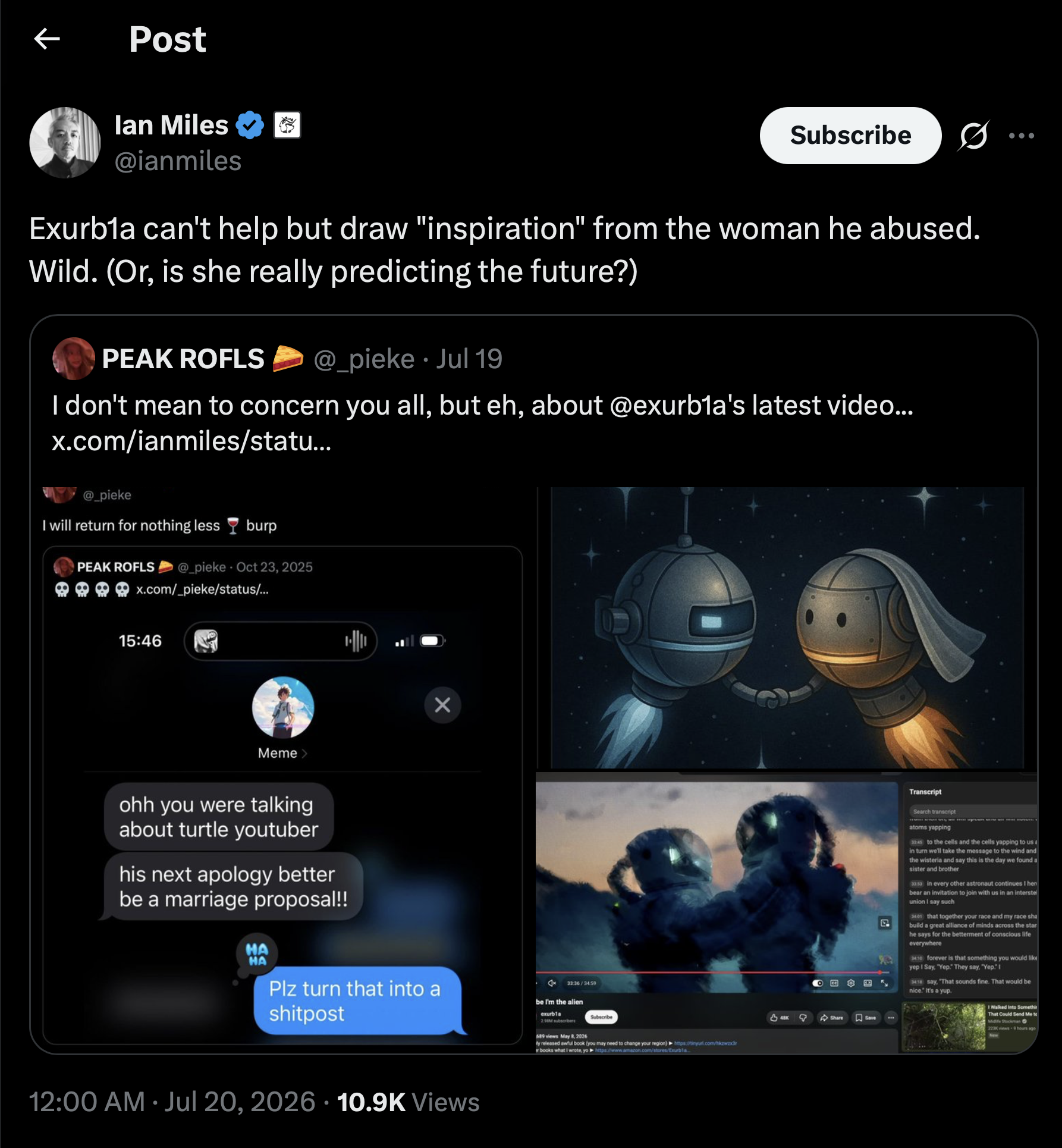
This article is part of a series. Please see The Dark Side of Justice for more information.
[This post was added after the original ending of the Dark Side of Justice series, given a past hidden prediction that came true which triggered the release of it.]
PhotoandGrime.com does not display third party advertisements because we believe information and knowledge that informs or protects the public, should be (clutter)free.
If you found this article informative and want to support the website, consider sharing it!
You can also show support by becoming a Patron or by buying a coffee.